

Performance Protection: The Elite Golfer's Maintenance System
How proactive structural maintenance and key performance indicators keep elite golfers on the course and out of the treatment room


I watched a professional golfer walk off the 11th hole last month, club in hand, grimacing with every step. He had been playing beautifully. Fourteen under through ten. Then something in his lower back seized up on a routine wedge shot, and his round was over.
He had not been injured. Not in the clinical sense. No acute trauma. No fall. No collision. He had simply run out of runway.
What happened to him is happening to golfers at every level right now. Not because golf is a dangerous sport. Because most golfers have no system for protecting their performance capacity before it fails.
This is the article I wish someone had handed that golfer six months ago.

The Injury Equation Nobody Talks About
Golf has an injury problem. It is not the kind that makes headlines because it does not look dramatic. No torn ACLs on a hard cut. No helmet-to-helmet collisions. Golf injuries are quiet, cumulative, and completely preventable.
Here is what the data tells us: 60 percent of touring professionals and 40 percent of amateur golfers sustain at least one golf-related injury per year. The lower back accounts for the largest share, followed by the lead wrist, the elbow, and the shoulder.
But here is what the data does not capture: how many of those injuries were not injuries at all. They were failures of maintenance.
There is a difference between a traumatic injury and a structural breakdown.
A traumatic injury is sudden and unavoidable. A structural breakdown is gradual, predictable, and stoppable, IF you know what to watch for.
Most golfers treat their bodies the way most people treat their cars: they ignore the warning lights until the engine stops. They play through tightness. They manage aches. They tell themselves they are just tired. And then something gives.
Elite performance maintenance operates from a completely different premise.
PRINCIPLE: The goal is never to recover from breakdown. The goal is to prevent it.
This requires two things: a systematic maintenance conditioning program and a set of structural and performance indicators that tell you how your body is holding up before a breakdown occurs.
That is what this article is going to give you.
Why Elite Golfers Break Down: The Real Mechanism
The golf swing is one of the most physically demanding movements in all of sport. That sounds counterintuitive. Golf does not look demanding. There is no sprinting. No contact. No explosive jumping.
But consider this: the average golfer makes 70 to 100 swings per round, not counting warm-up and practice. Each swing generates rotational forces in excess of eight times your body weight across the lumbar spine. You do this repeatedly, with only brief recovery intervals, across four to five hours.
And you do it with a body that is, in most cases, already structurally compromised from sitting, stress, poor recovery, and inadequate preparation.
The breakdown mechanism works in three stages.

Stage 1: Cumulative Load Exceeds Recovery Capacity
Your tissues can handle an enormous amount of stress. Muscle, tendon, fascia, and joint structures are designed to absorb force and adapt. But they need recovery time to do it.
When the load you apply, rounds played, practice volume, swing speed, travel fatigue, physical and mental stress consistently exceeds your recovery capacity, tissue quality degrades. Micro-damage accumulates faster than it repairs.
Most golfers do not feel this happening. The body is remarkably good at compensating. You adjust without realizing it. Your swing changes subtly. Your range of motion decreases. You lose a few yards. You blame the weather or the equipment or a bad range session.
The real cause is Stage 1 breakdown that has been ignored for months.

Stage 2: Structural Compensation Patterns Emerge
When one area of the body loses capacity, adjacent structures compensate. This is not a choice. It is a neurological imperative. Your body will always find a way to complete the movement.
Tight hips force the lower back to over-rotate. A restricted thoracic spine loads the shoulder and elbow. A weak core pushes force into the lumbar facets. Every compensation pattern transfers stress to a structure not designed to handle it.
This is where most golf injuries actually originate. Not from the final swing that produced the pain, but from months of compensated movement loading the wrong structures with the wrong forces.
Stage 3: The Critical Threshold
Compensation patterns have limits. Every tissue you have been loading incorrectly has a failure threshold. When cumulative stress crosses that threshold, breakdown becomes symptomatic.
This is the moment the golfer I described walks off the 11th hole. It looks sudden. It was not. It was the predictable endpoint of an ignored process.
KEY INSIGHT: By the time a golf injury becomes symptomatic, the process that caused it has been building for 3 to 6 months. This is why reactive treatment is always playing catch-up. The window for prevention is long. You just have to know what to measure.

The Key Performance Indicators: Your Early Warning System
Elite golfers and the coaches who work with them operate with a set of measurable benchmarks that tell them how the body is responding to training and competition load. When indicators drop below threshold, the protocol adjusts before breakdown occurs.
Here are the six indicators that matter most.
Indicator 1: Hip Internal Rotation

Why it matters: Internal hip rotation is the primary driver of pelvic and hip rotation in the golf swing. When it decreases, the lower back compensates. Most golfers have no idea what their baseline is — and no way of knowing when it has dropped.
How to test it: Sit at the edge of a chair with your knees at 90 degrees and your feet hanging free. Without moving your thigh, rotate your foot outward as far as it will go. Measure the angle from vertical. Your lead hip and trail hip should both reach 35 degrees of internal rotation or more. Asymmetry greater than 10 degrees is a red flag.
What a drop tells you: Hip capsule restriction is developing. Joint mobility is degrading. If uncorrected, your lower back will absorb the next several hundred swings at a force it cannot safely handle.
Indicator 2: Thoracic Rotation Range

Why it matters: Your thoracic spine is responsible for the majority of the rotational capacity in your golf swing. A restricted T-spine is one of the most common precursors to shoulder injury, rib stress, and cervical strain in golfers.
How to test it: Sit in a chair with your arms crossed over your chest. Rotate left and right as far as you comfortably can. You should achieve approximately 45 degrees of rotation in each direction. Sit with your back against the wall and repeat. If your rotation decreases significantly with the wall behind you, your rotation is being generated from the lumbar spine — not the thoracic. That is a compensation pattern.
What a drop tells you: Your thoracic spine is locking up. Your shoulder complex or lower back is likely about to absorb a disproportionate load.
Indicator 3: Single-Leg Balance Duration
Why it matters: The golf swing requires the ability to control your body on a single leg through impact and into the finish. Balance capacity reflects hip stability, proprioceptive function, and neuromuscular control — all of which degrade under fatigue and cumulative load.
How to test it: Stand on your lead leg with your eyes closed. Time how long you can maintain balance without your raised foot touching down or your stance foot shifting. You should hold 20 seconds or more. Test both legs. Significant asymmetry or a drop in performance over consecutive test days signals neuromuscular fatigue or hip stability degradation.
What a drop tells you: Your neuromuscular system is fatigued or your hip stabilizers are being inhibited. Either condition increases injury risk on every swing.
Indicator 4: Grip Strength Baseline

Why it matters: Grip strength is a reliable proxy for overall neuromuscular readiness and recovery status. When grip strength drops 10 percent or more from your personal baseline, your system is telling you it has not recovered from recent load.
How to test it: Use a hand dynamometer. Test your dominant hand three times and record the peak. Establish your baseline over two weeks of testing at the same time of day. Any reading below 90 percent of baseline is a load management signal.
What a drop tells you: You are under-recovered. Competing or practicing at high intensity from this state significantly increases injury probability.
Indicator 5: Morning Resting Heart Rate
Why it matters: Resting heart rate elevation above your personal baseline is one of the clearest signals of systemic under-recovery. When your body has not recovered from prior load — physical or psychological — your heart rate reflects it before your performance does.
How to test it: Measure your heart rate every morning before getting out of bed. Use a finger pulse oximeter or wearable device. Establish your baseline over two to three weeks. A reading 5 or more beats above your average baseline on a competition or heavy practice day is a green light to reduce load or move to active recovery work rather than high-intensity training.
What a drop tells you: Actually, what an elevation tells you is that you are not recovered. This is the body’s clearest early-warning signal. Most golfers never check it.
Indicator 6: Lumbar Flexion/Extension Tolerance
Why it matters: The lower back is the most commonly injured area in golf. Monitoring its daily tolerance is the closest thing to a direct injury prevention signal you can get without imaging.
How to test it: Every morning, perform five slow forward folds and five slow gentle backward extensions. Rate your comfort on a simple 0-to-10 scale. Establish your normal. When discomfort in either direction rises above your baseline by two or more points on consecutive mornings, something is building that needs to be addressed before you load it with another round of golf.
What a drop tells you: Your lumbar structures are under load stress. Continuing at full swing intensity before this normalizes is how a minor issue becomes a major one.

The Maintenance Conditioning System
Monitoring indicators without a corresponding maintenance system is like having a dashboard full of warning lights and no mechanic. The indicators tell you what is happening. The conditioning system is what you do about it.
Elite performance maintenance operates on three tiers: daily maintenance, weekly structural restoration, and periodic deep tissue reset. Each tier targets a different component of the breakdown mechanism.
Tier 1: Daily Maintenance — 10 to 15 Minutes
This is your non-negotiable foundation. Every day. Before your first swing, before your first practice session, before any round. It takes less time than the warm-up most golfers skip. This is where the Start Strong Warm up System is the perfect tool for the job.
The Morning 6-Point Check (5 minutes)
Perform this immediately after your lumbar tolerance test above. It is active assessment, not passive stretching.
Hip 90/90 Rotational Transition — 5 slow reps per side. Assesses and restores hip internal and external rotation simultaneously.
Cat-Camel Sequence — 10 slow repetitions. Identifies segmental stiffness in the lumbar and thoracic spine before it becomes symptomatic pain.
Thread the Needle Rotation — 8 reps per side. Restores thoracic rotation and identifies restriction before loading it with a swing.
Single-Leg Hip Hinge — 5 reps per side. Tests and activates glute function and hip stability simultaneously.
Pallof Press Isometric Hold — 20 seconds per side. Engages the anti-rotation core system that protects the lumbar spine under swing load.
Diaphragmatic Breathing Reset — 5 slow cycles with full exhale. Activates the parasympathetic nervous system, resets intra-abdominal pressure, and primes the deep stabilizer system for load.
The Pre-Round Activation Protocol (5 to 10 minutes)
This is separate from and in addition to the morning check. Do it at the course, not the hotel.
Glute Bridge Progression — 15 bodyweight, 10 single-leg. Activates the posterior chain before the first swing loads it.
Hip Flexor Stretch with Rotation — 60 seconds per side. Releases the accumulated hip flexor tension from sitting and travel.
Lateral Band Walks — 15 steps per direction. Activates the hip abductors that stabilize the pelvis through the swing.
Progressive Swing Sequence — 10 swings at 50 percent, 10 at 70 percent, 5 at 90 percent. Do not begin at full swing speed. The neuromuscular system needs to be sequenced into load.
Wrist and Forearm Mobilization — 2 minutes. The most overlooked pre-round protocol. The wrists and forearms generate enormous load in the golf swing and are almost never prepared for it.

Tier 2: Weekly Structural Restoration — 45 to 60 Minutes
Three times per week. This is where you maintain and rebuild the structural capacity your performance depends on. It is not a workout in the traditional sense. It is targeted maintenance.
Joint Mobility Block (15 minutes)
Hip Capsule Mobilization — banded hip distraction, 2 minutes per side. Directly targets the joint capsule restrictions that drive lower back compensation.
Thoracic Spine Mobilization — foam roller extension work, 90 seconds at three positions. Restores the T-spine rotation that your swing demands.
Shoulder Complex Mobility — band-assisted flexion, extension, and rotation circuit, 10 minutes. Maintains the shoulder range of motion that erodes under repetitive swing load.
Stability and Strength Block (25 minutes)
Single-Leg Romanian Deadlift — 3 sets of 10 per side. Builds the hip stability and posterior chain strength that protects the lower back through the swing.
Rotational Pallof Press — 3 sets of 12 per side. Conditions the anti-rotation core that stabilizes the lumbar spine under torsional load.
Half-Kneeling Cable Rotation — 3 sets of 12 per side. Trains the rotational strength pattern in a position that directly transfers to the golf swing.
Single-Leg Balance Progression — 30 seconds, 30 seconds with eyes closed, 30 seconds on an unstable surface. Builds and maintains the proprioceptive capacity that performs under pressure.
Dead Bug Progression — 3 sets of 10 per side. Re-establishes deep core stability, breathing coordination, and lumbar spine protection.
Soft Tissue Reset (10 minutes)
This is not optional maintenance. It is structural maintenance.
Foam Rolling Protocol — quadriceps, IT band, thoracic spine, posterior hip. 60 seconds per area. Reduces tissue density and adhesion accumulation from repetitive swing load.
Targeted Trigger Point Work — any area showing two or more on your daily discomfort scale. Use a lacrosse ball or trigger point tool. 90 seconds per area.
Tier 3: Periodic Deep Tissue Reset
Every four to six weeks. This is not optional if you are competing or playing at high volume.
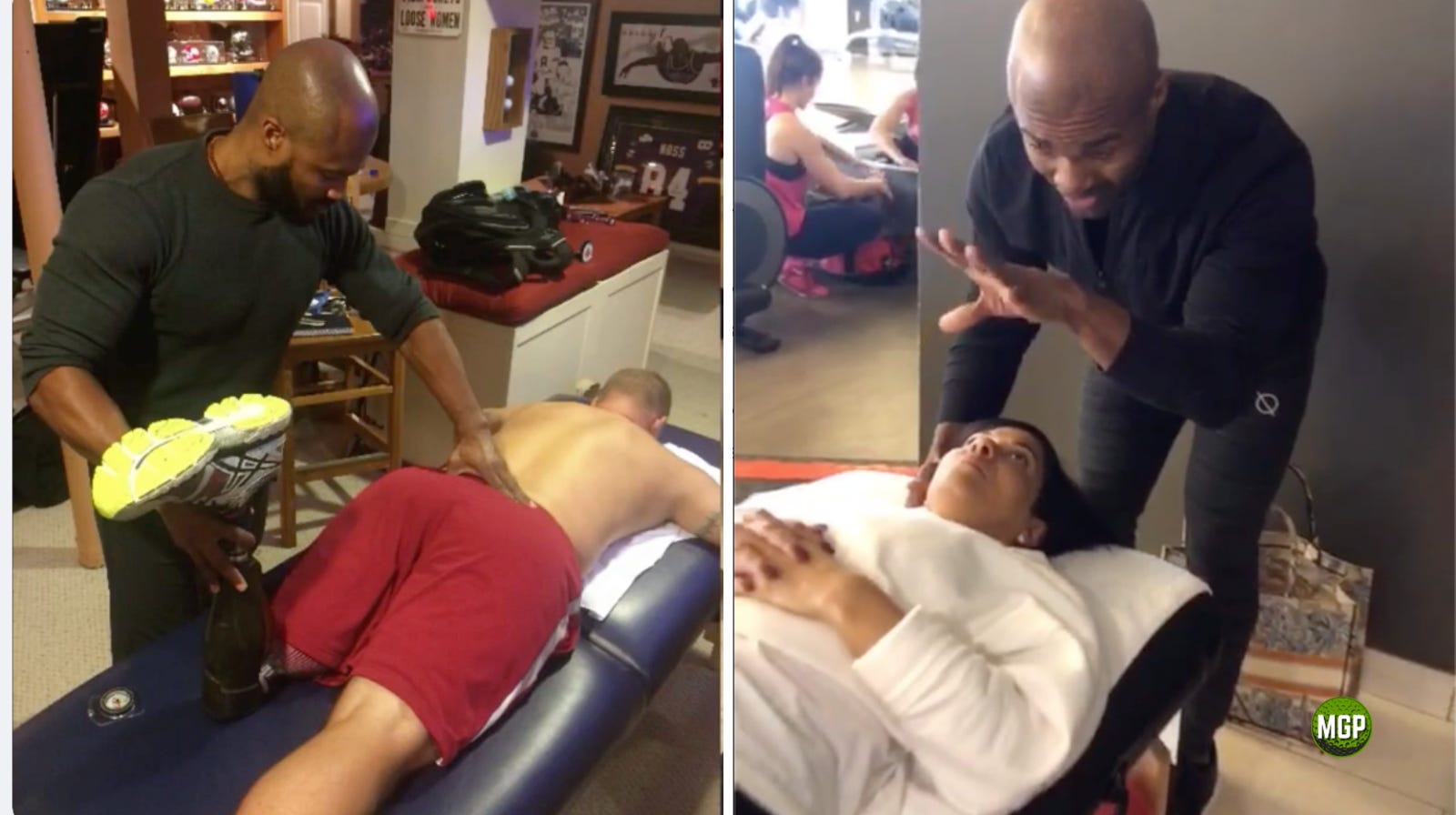
Professional manual therapy — massage, ART, chiropractic, or a skilled practitioner who understands golf performance demands — is the most efficient way to clear the tissue load accumulation that daily and weekly maintenance cannot fully address. This is not recovery from injury. This is structural maintenance at the system level.
Think of it as an oil change. You do not wait until the engine burns to schedule one.
MAINTENANCE REALITY CHECK: Most amateur golfers spend more money on a new wedge than they invest in the body holding the club. Equipment does not break down under load. Your body does. Protect the asset.

The Decision Protocol: What to Do When Indicators Drop
Monitoring indicators only creates value if you act on what they tell you. Here is the decision framework.
Green — All Indicators at Baseline
Full training and competition load is appropriate. Complete your pre-round activation and proceed normally.
Amber — One Indicator Below Threshold
This is the critical management zone. Most golfers in this zone push through at full intensity. Elite performers in this zone do not.
Reduce swing practice volume by 30 percent.
Add 10 minutes to your pre-round activation protocol targeting the flagged indicator.
Complete your full Tier 2 restoration session within 24 hours.
Monitor the flagged indicator daily until it returns to baseline.
Red — Two or More Indicators Below Threshold
This is a load management day. Not a rest day — a managed activity day.
Competition: compete, but do not practice before or after. Complete your full activation, play your round, finish with a full soft tissue reset.
Practice day: replace your planned practice session with Tier 2 restoration work only. No full swing practice.
If two or more indicators remain below threshold for three consecutive days, a professional manual therapy session is the priority before returning to full load.
IMPORTANT: The Red protocol is not weakness. It is intelligent load management. The golfers who cannot make this call are the ones walking off the 11th hole holding their backs.

The Seasonal Framework: Planning Protection Into Your Year
Performance protection is not just daily and weekly. It requires a seasonal structure that accounts for competition peaks, recovery blocks, and maintenance phases.
Competitive Season (Peak Events)
During your highest-priority competition windows, reduce training load by 30 to 40 percent and increase maintenance volume. You are not building fitness during competition season. You are protecting and expressing what you have already built.
Daily indicator monitoring is mandatory.
Tier 2 restoration twice per week minimum.
Deep tissue reset every three weeks, not six.
Sleep priority: 8 to 9 hours. Recovery happens in sleep. No amount of maintenance compensates for chronic under-sleep.
Shoulder Season (Between Events)
This is where structural capacity is built. Training volume increases. Intensity increases. Maintenance volume decreases slightly because the training itself drives adaptation.
Tier 2 restoration twice per week.
Strength and conditioning three times per week.
Deep tissue reset every four to six weeks.
Begin addressing any persistent indicator flags with professional support.
Off-Season (Structural Rebuild)
The most neglected phase in amateur and professional golf. Most golfers take a few weeks off and then return to hitting balls. Elite performers use the off-season to rebuild the structural foundation their performance runs on.
Address all accumulated structural issues with professional manual therapy.
Complete a systematic mobility and stability restoration program — not a training program.
Build the structural capacity benchmarks back to or above their starting points before beginning swing-focused work.
Re-establish all six performance indicators at optimal baseline before increasing load.

The Golfer Who Stays on the Course Wins
The best swing in the world means nothing from the training room.
Performance protection is not about being cautious. It is not about limiting your game. It is about building the maintenance infrastructure that allows you to compete at full intensity, round after round, season after season, without the structural debt that eventually forces you off the course.
The six indicators are your early warning system. The three-tier maintenance system is your protection protocol. The decision framework is your management tool.
Start measuring. Start maintaining. The results compound — not just in rounds played without injury, but in the consistency, the power, and the longevity that come from a body that is structurally protected and physically prepared.
That golfer on the 11th hole had the game. He did not have the system.
Now you do.
A Note From Terrence
The High Performance Golf Newsletter launched over years ago. Every article, every protocol, every framework, every clinical deep dive has been mostly free. Very few pay walls. The full articles.
That is a choice I made because I believe this information should be in the hands of serious golfers, not locked behind a gate. And based on the response, it has been the right call. Between 5,000 and 6,000 of you read every issue. That number has never stopped being humbling.
Here is the honest reality: TEN of you are paid subscribers.
I am not writing this to make you feel guilty. I am writing it because that gap is not sustainable, and you deserve to know. Producing content at this level, the research, the clinical depth, the consistency takes real time and real resources. Right now, the math does not work without a change.
The change I am considering is a hard paywall. The majority of future articles would be for paid subscribers only. Free issues would become the exception.
But I would much rather not do that. I would rather this newsletter stay free for everyone, supported by the readers who find genuine value in it.
If this newsletter has helped your game. If you have taken something from it and used it on the course consider becoming a paid subscriber. That is what keeps this free for the other 5,900 people who read it.
Thank you for reading. Four years in, you are still the reason I keep going.
