

The One Joint That Controls Your Golf Swing
The hidden joint restriction forcing your lower back to pay the price—and the 10-minute protocol that fixes it

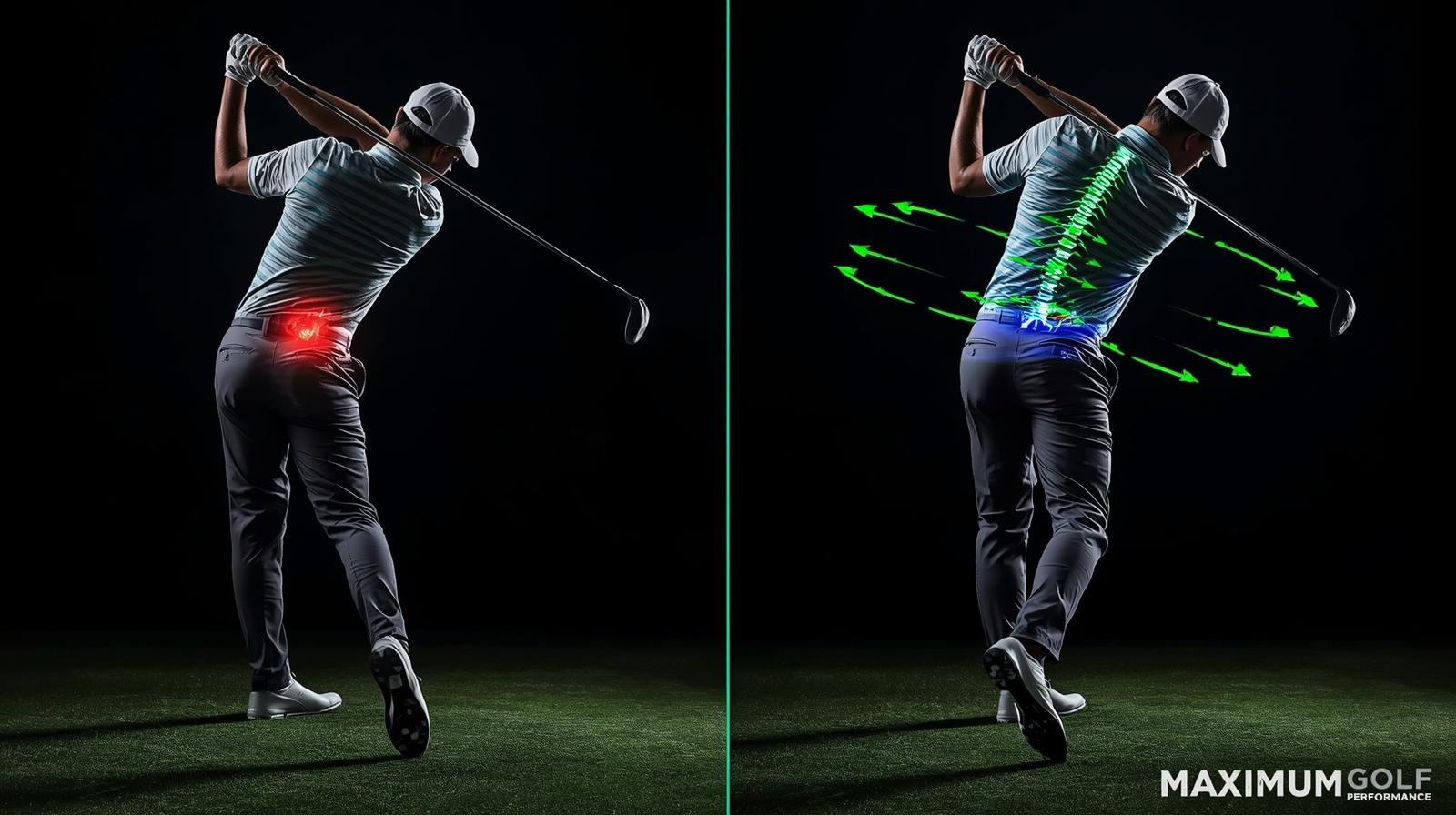
Every serious golfer knows this moment.
You’re on the range. You hit three perfect drives in a row. Pure power. Then something tightens in your lower back.
By the 12th hole, you’re managing pain instead of managing the course. By the 18th, you just want to finish without hurting.
Here’s what most golfers miss: that back pain isn’t a back problem. It’s a hip problem in disguise.
I’ve spent 25 years working with tour players and elite amateurs. I can tell you this with complete certainty—your hips are either your swing’s greatest weapon or its biggest weakness. There’s no in-between.
Today, I’ll show you exactly why tight hips set up your lower back for injury. You’ll learn the four main causes of these problems. And you’ll get the proven solution that’s kept thousands of golfers swinging strong and pain-free.
The Chain Reaction: What Happens When Your Hips Can’t Do Their Job
Your golf swing needs about 45-50 degrees of hip rotation during the backswing. That’s not optional. It’s required for power while keeping your spine angle steady.
But here’s where things go wrong.
When your hip can’t rotate enough, your brain doesn’t tell you to stop. Instead, it finds a way around the problem.
And that workaround is almost always your lower back.
Your lower back starts doing the rotation work that your hips should handle. The problem? Your lower back was built for staying stable, not for rotating. It can bend forward and back pretty well. But rotation? That’s not its job.
Think of it this way: you’re asking an accountant to build a house. They might figure it out. But it’s not their job. They don’t have the right tools. And something will break.
This is the chain reaction. It happens the same way in golfer after golfer:
Tight hips → Too much lower back rotation → Wrong loading patterns → Tissue damage → Pain → Swing changes → Loss of power → More problems
I’ve seen tour players add 15 yards to their drives with new training. Three weeks later they had severe back spasms. Why? They built power on top of hip problems. This forced their spine to handle forces it wasn’t designed for.
I’ve worked with scratch golfers—real athletes—who couldn’t understand why their back “just went out” during practice. The answer was always the same. Their hips had been failing them for months. Their lower back finally gave out.
Understanding the Problem: How Hips and Spine Work
Let me explain the mechanics. Understanding this will help you see why my solutions work so well.
Your hip is a ball-and-socket joint. It’s designed for movement in all directions: bending, straightening, moving side to side, and—most important for golf—rotation. When working right, your hips can rotate on their own. Your pelvis can turn while your spine stays at the right angle.
This is what experts call the “X-Factor.” It’s the difference between hip turn and shoulder turn. But here’s what gets missed—you can’t create good separation if your hips are stuck.
When hip rotation is limited, your body takes the easy path. Your mid-back and lower back can rotate somewhat. So they step in to help. But there’s a problem. Your lower back should only rotate about 5-10 degrees in your golf swing.
When it’s forced to rotate 20-25 degrees because your hips are locked up, bad things happen. The joints, discs, and muscles around your spine get stressed in wrong ways.
Do this 100 times on the range. Do it 80 times during a round. Suddenly you’re not dealing with a single injury. You’re dealing with damage that builds up over time.
The Four Main Causes of Hip Problems
Over two decades working with elite golfers, I’ve found four main reasons for hip problems. Understanding which one is limiting you is key to fixing it.
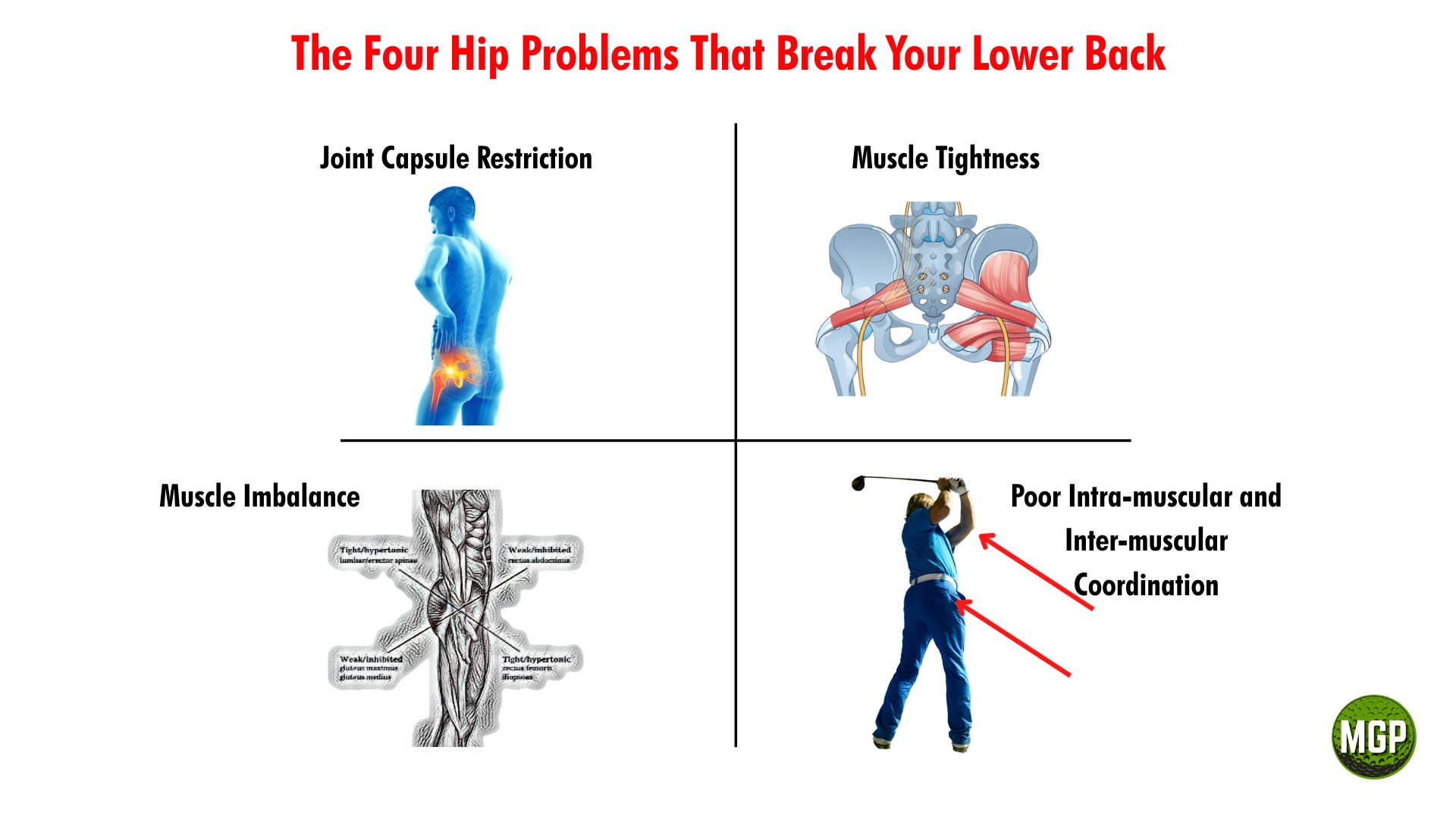
1. Tight Joint Capsule
Your hip joint is wrapped in a thick, strong capsule. Think of it like a leather sleeve around the ball-and-socket. When this capsule gets tight—from injury, too much sitting, or repeating the same movements—it physically limits how far your hip can rotate.
This is pure mechanical blocking. No amount of muscle stretching will fix a tight joint capsule. You need specific moves that create space in the joint itself.
The sign: Your hip feels “blocked” at a certain point. Like something physical is stopping further movement.
2. Tight Muscles
We covered this a lot in Start Strong. It’s worth repeating: tight muscles act like parking brakes on your joints.
For golfers, the usual problems are:
Hip flexors: Shortened from sitting. These limit hip opening and create that “Donald Duck” posture where your butt sticks out too much. This loads your lower back wrong and makes it weak during rotation.
Hip rotators (deep in glute area): These get overworked in golfers because they’re covering for weak glutes. When tight, they block internal rotation on your lead hip (left hip for right-handed golfers).
Inner thighs: Often ignored. These muscles steady your pelvis during weight shift. When tight, they limit the hip movement needed for proper weight shift and rotation.
The sign: You feel a clear stretch or pull when trying to rotate your hip. The tightness gets a bit better after warming up.
3. Muscle Imbalance
Here’s where it gets interesting. Sometimes your hips aren’t stuck because muscles are too tight. They’re stuck because muscles are too weak.
Remember Start Strong Principle #1: *A tight muscle is a weak muscle.*
But the opposite is also true: a weak muscle creates tightness somewhere else.
The classic golf example: weak glutes. Your glute max should be the main engine for hip opening and rotation. Your glute med should steady your pelvis during the single-leg loading in your golf swing.
When these muscles don’t fire right—called “gluteal amnesia”—your body uses smaller, less efficient muscles to do their job. These muscles weren’t built for that work. So they get tight, tired, and painful.
Meanwhile, your hip joint isn’t getting the stability it needs. So your nervous system limits range of motion to protect you. Your brain says, “We don’t have control here, so we’re not going there.”
The sign: Your hip restriction comes with weakness. You might feel unstable on one leg. Or notice your knee caves inward during your downswing.
4. Poor Coordination
This is the most advanced problem. And the one that separates good golfers from great ones.
Internal coordination means how well your muscle fibers work within a single muscle. Between-muscle coordination means how well different muscles work together in sequence.
In the golf swing, your hips don’t work alone. Hip rotation is a coordinated team effort:
- Core muscles fire first to create a stable base
- Glutes start the movement
- Hip rotators control the motion
- Inner and outer thigh muscles steady throughout
- All of this happens while keeping perfect timing with your upper body
When this coordination breaks down—often from wrong movement patterns or incomplete injury recovery—you lose access to ranges you technically have.
Your flexibility might be fine when lying on a table doing tests. But put you in golf posture, add speed, and those ranges disappear.
The sign: Your hip mobility changes a lot based on position, speed, or how tired you are. You might have great range alone but lose it under load.
The 3-Minute Hip Test
