

Your Golf Swing Doesn't Start in Your Hips. It Starts Here.
A researcher spent decades proving that human locomotion starts in the spine — not the legs. What he discovered changes everything about how you think about your golf swing.

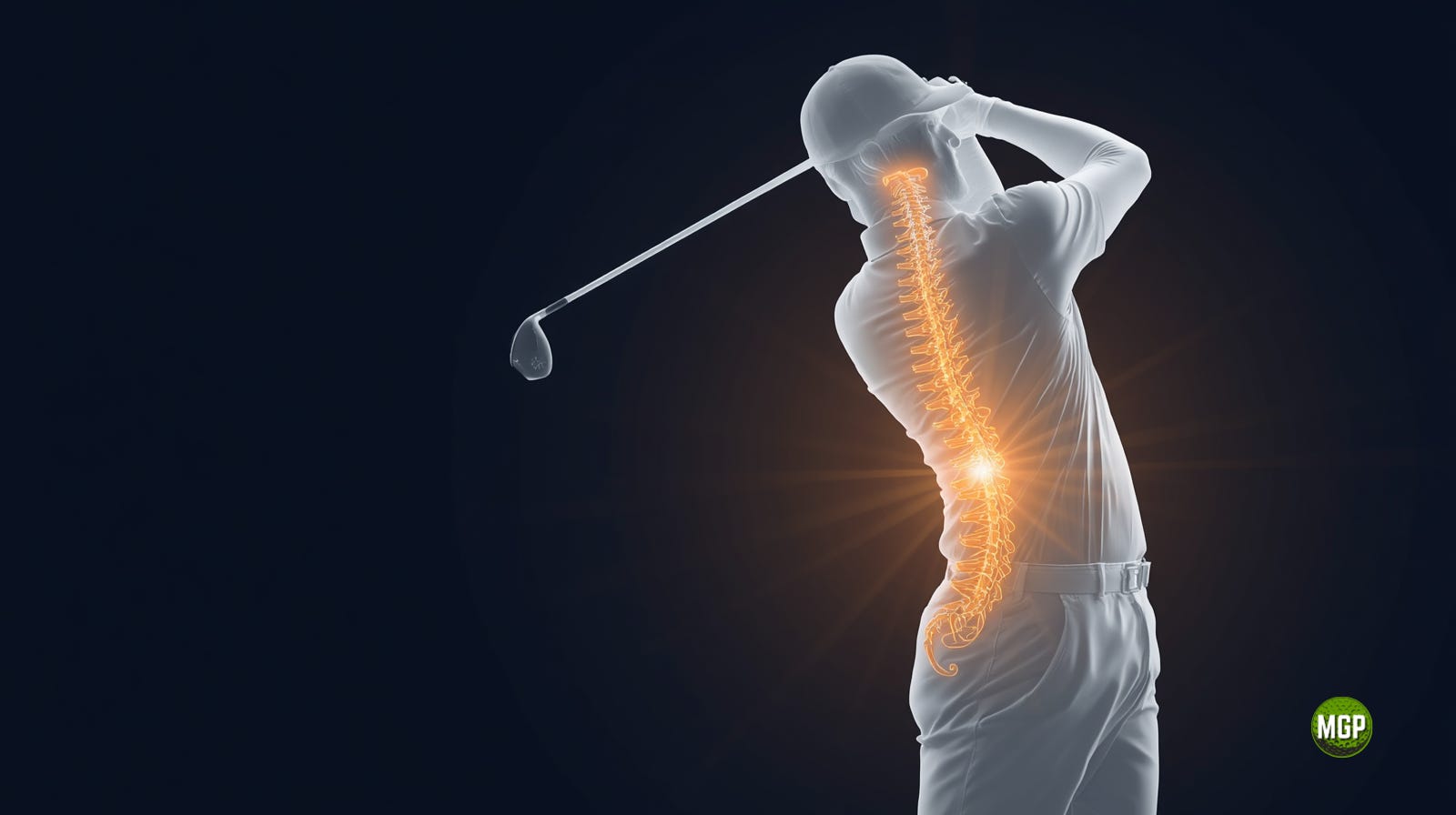
Watch any amateur golfer struggle with distance and you’ll see the same pattern every time.
They grip harder. They swing faster. They take lesson after lesson. They buy better equipment. They study swing videos until they are cross-eyed.
And none of it moves the needle the way it should.
Here’s why.
They’re fixing the wrong thing. And until that changes, nothing else will.
The Lesson Your Golf Instructor Never Learned
In the 1980s, a nuclear physicist named Dr. Serge Gracovetsky published a theory that turned the biomechanics world upside down.
He called it the Spinal Engine.
Gracovetsky wasn’t a golf coach. He wasn’t a physical therapist. He wasn’t even interested in golf. He was an engineer, and engineers look at systems differently than everyone else. They start with the source, not the symptoms.
He looked at the human body and asked a question no one in sports performance was asking: where does movement actually start?
Not where do the arms go. Not how do the hips turn. Not what should the club path look like. But where does the primary drive signal originate in the body during locomotion?
His answer wasn’t the legs.
It wasn’t the hips.
It was the spine.
Specifically, the thoracolumbar junction. The hinge point where the lumbar spine meets the thoracic spine. That junction, Gracovetsky argued, is the engine of the human body. Everything else is downstream.
This was a radical claim in 1985. Forty years of peer-reviewed biomechanics research has proven him right.
The Study That Changed Everything
To test his theory, Gracovetsky did something most researchers wouldn’t have thought to do.
He studied subjects who had no lower limb function. People who couldn’t use their legs or had no legs at all. He filmed them propelling themselves forward by sitting on the floor and moving on their sit bones.
With no legs involved, no knee push-off — their spines produced the exact same coupled rotational pattern as a healthy person walking on two feet.
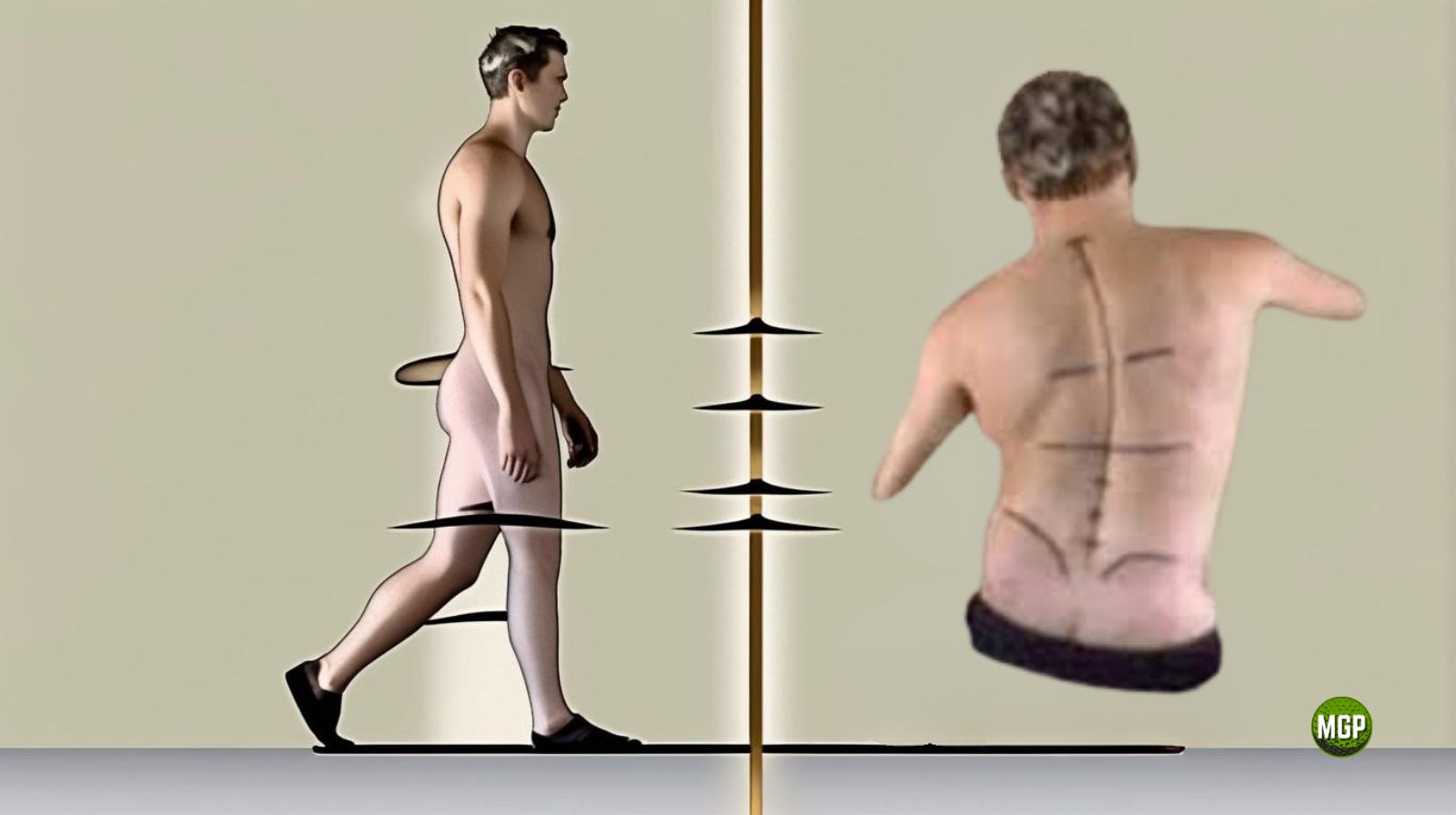
The thoracolumbar junction was rotating and counter-rotating, driving the pelvis forward in a perfectly coordinated wave. The spinal engine was running on its own. Independently. Without any input from the limbs whatsoever.
Gracovetsky’s conclusion was as simple as it was revolutionary.
The legs are not the engine. They are the expression of the engine.
Think about what that means. Every step a healthy person takes; every rotation, every stride, every lateral shift is initiated by the spine and transmitted outward. The legs follow. The arms follow. The clubhead follows.
If the engine is healthy, everything downstream is efficient.
If the engine is compromised, everything downstream is a compensation.
What Does This Have to Do with Your Golf Swing?
Everything.
At its core, a golf swing is a rotational movement driven from the center of the body, expressed through the arms, and delivered through the clubhead at impact. If Gracovetsky is right and the research is now clear that he is, then the primary driver of that rotation is not your hip turn.
It’s the coupled motion of your thoracolumbar spine.
And here’s where it gets important for you personally.
If that spinal engine is compromised. If the structural alignment that allows it to generate and transfer rotational force is off, then no amount of hip mobility work, no swing plane adjustment, no new driver, and no lesson from even the best instructor will give you what you’re looking for.
You’re not undertrained. You’re structurally misaligned.
And you can’t lesson or gadget your way out of a structural problem.
The Three Structures That Control the Engine
The spinal engine doesn’t operate in isolation. It depends on the coordinated position and function of three structures. I call them the Three Amigos.
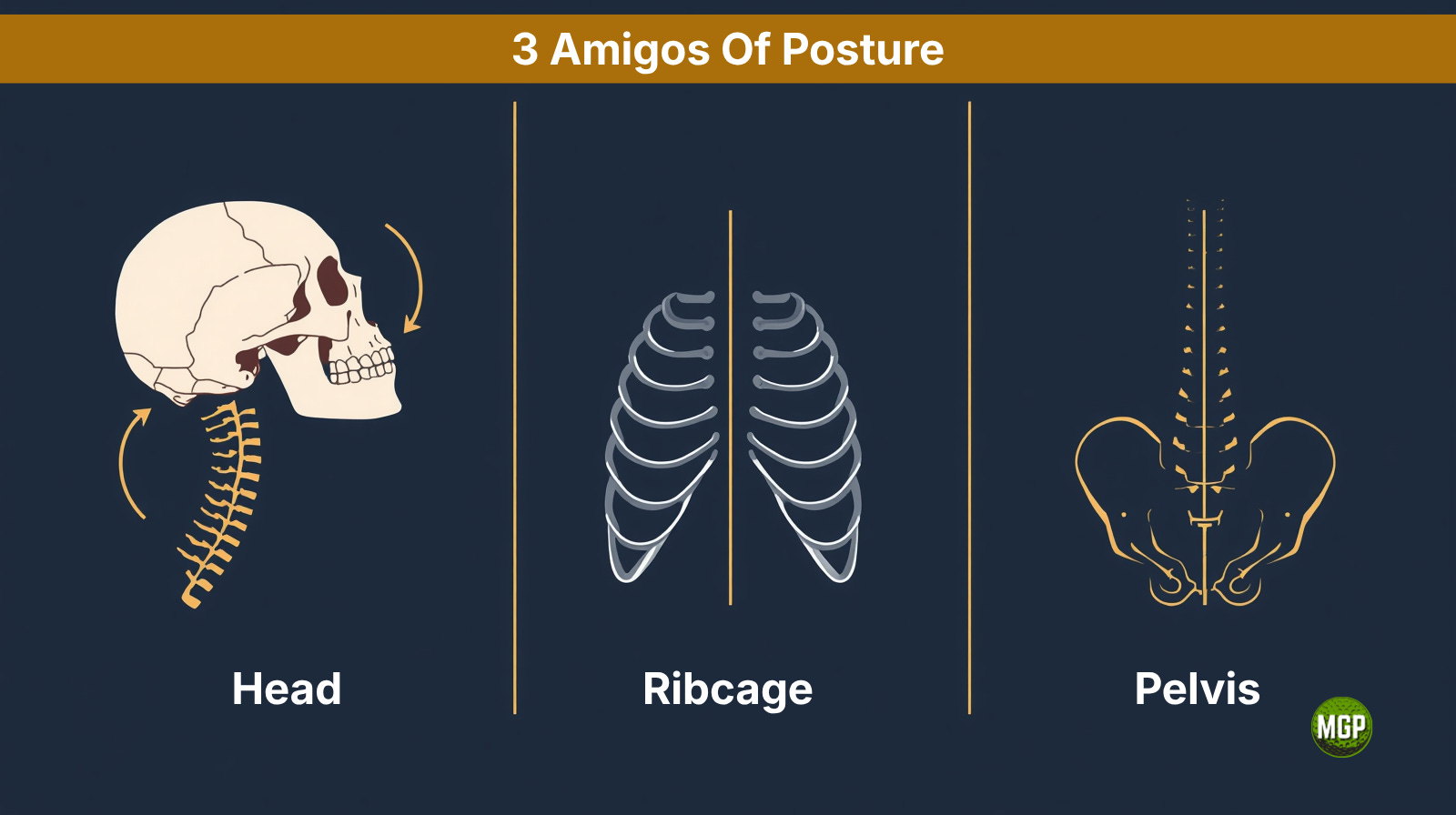
When all three are aligned, the engine fires cleanly. When any one of them is out of position, the chain breaks and your body compensates. Every compensation pattern in your swing traces back to one or more of these three structures.
The Head
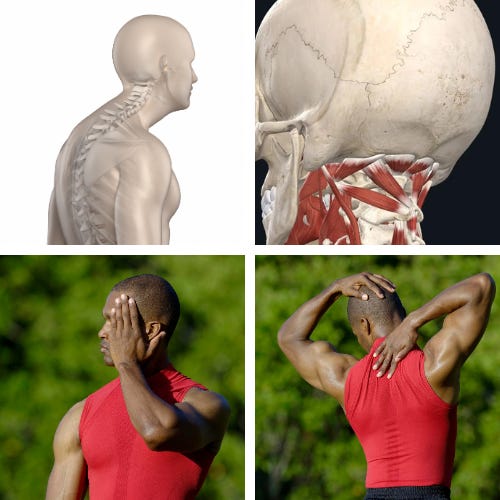
Your head weighs between 10 and 12 pounds. That’s a bowling ball balanced on top of your cervical spine. When it sits two inches forward of your shoulders, which it does in the majority of adult golfers I assess that forward position creates a compensatory chain reaction that travels the entire length of your spine.
The cervical curve flattens. The thoracic curve rounds. The lumbar curve collapses. The thoracolumbar junction loses its ability to generate the coupled rotation that drives your swing.
Here’s what that feels like from inside the body: You don’t notice the head position. You feel it as a loss of thoracic rotation. Your backswing gets shorter. Your follow-through gets restricted. Your instructor tells you to turn more.
But you can’t turn more. The engine isn’t firing.
The correction isn’t “turn more.” The correction is restoring the cervical curve that allows the thoracic spine to move freely in the first place.
The Rib Cage
The thoracic spine lives inside the rib cage. It’s housed there. Which means when the rib cage collapses forward which it does when the head is forward, thoracic rotation is mechanically restricted. The structure prevents the motion.
This is not a flexibility problem. No amount of stretching a locked rib cage will give you more backswing.
This is a structural problem.
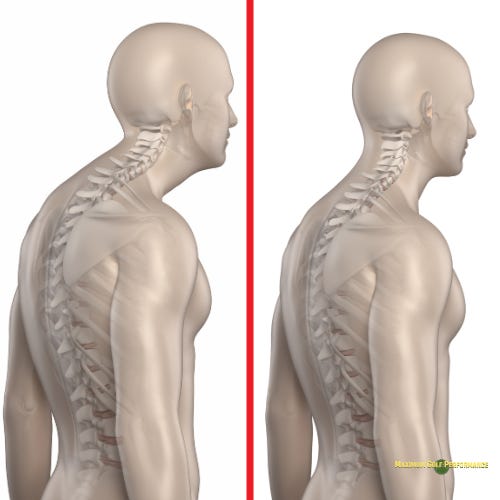
A collapsed rib cage creates what’s called Upper Crossed Syndrome. The deep cervical flexors and lower trapezius switch off. The upper trapezius and pec minor take over. The entire shoulder complex rounds forward. The glenohumeral joint compresses anteriorly. And suddenly your backswing looks like you’re trying to swing with your shoulders wrapped in a straitjacket.
I want to be clear about this: if you have a short backswing, I don’t care what your instructor has told you about shoulder turn. Your rib cage needs to be assessed and addressed before anything else. Full stop.
The Pelvis
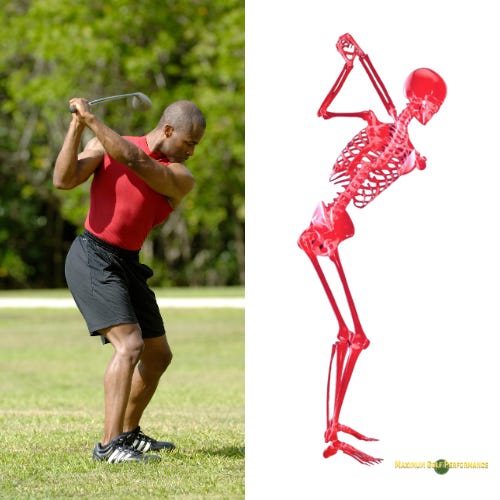
The pelvis is where the spinal engine delivers its output. It’s the transmission. The engine fires in the thoracolumbar junction, and the pelvis is the structure that converts that rotation into movement.
But when the pelvis is anteriorly tilted tipped forward the lumbar spine goes into hyperlordosis, the glutes inhibit, and the hip flexors shorten and tighten. This is Lower Crossed Syndrome.
You know this golfer. He has a C-posture or an S-posture at address. He loses his spine angle in the downswing. He comes over the top. He slides instead of rotates. He hits with his hands.
His instructor has told him to stay in his posture, fire his hips, and stop sliding. And the instruction is technically correct.
But the pelvis can’t execute those instructions because the engine it’s supposed to transmit isn’t generating clean rotation in the first place. The glutes that are supposed to stabilize it are switched off. The hip flexors that are supposed to release are stuck in a shortened position.
You can’t coach your way around a dysfunctional transmission.
Why Your Lessons Aren’t Sticking
Let me give you a composite picture.
I’ve worked with golfers at every level. Scratch players, club champions, single-digit handicaps, and 20-plus handicaps who’ve been playing for 30 years. And the pattern I see in players who plateau is consistent.
Their swing instruction is technically correct. Their instructor is good. Their practice is disciplined. But their head is two inches forward. Their rib cage is collapsed. Their pelvis is anteriorly tilted. The Three Amigos are all out of position. And the spinal engine that should be driving their rotation is running on maybe 50 percent of its capacity.
Swing instruction lands on the body like computer code runs on the hardware. When the hardware is broken, the code doesn’t execute correctly no matter how clean it is.
You can’t swing your way out of a structural problem.
You fix the structure first. Then the instruction lands.
This is the body-first principle. It’s not a philosophy. It’s a logical sequence based on how the neuromuscular system actually works. And it’s what separates golfers who improve steadily and who take a lesson and immediately feel the change, from golfers who stay stuck at the same handicap for a decade.
The Engine Is Trainable
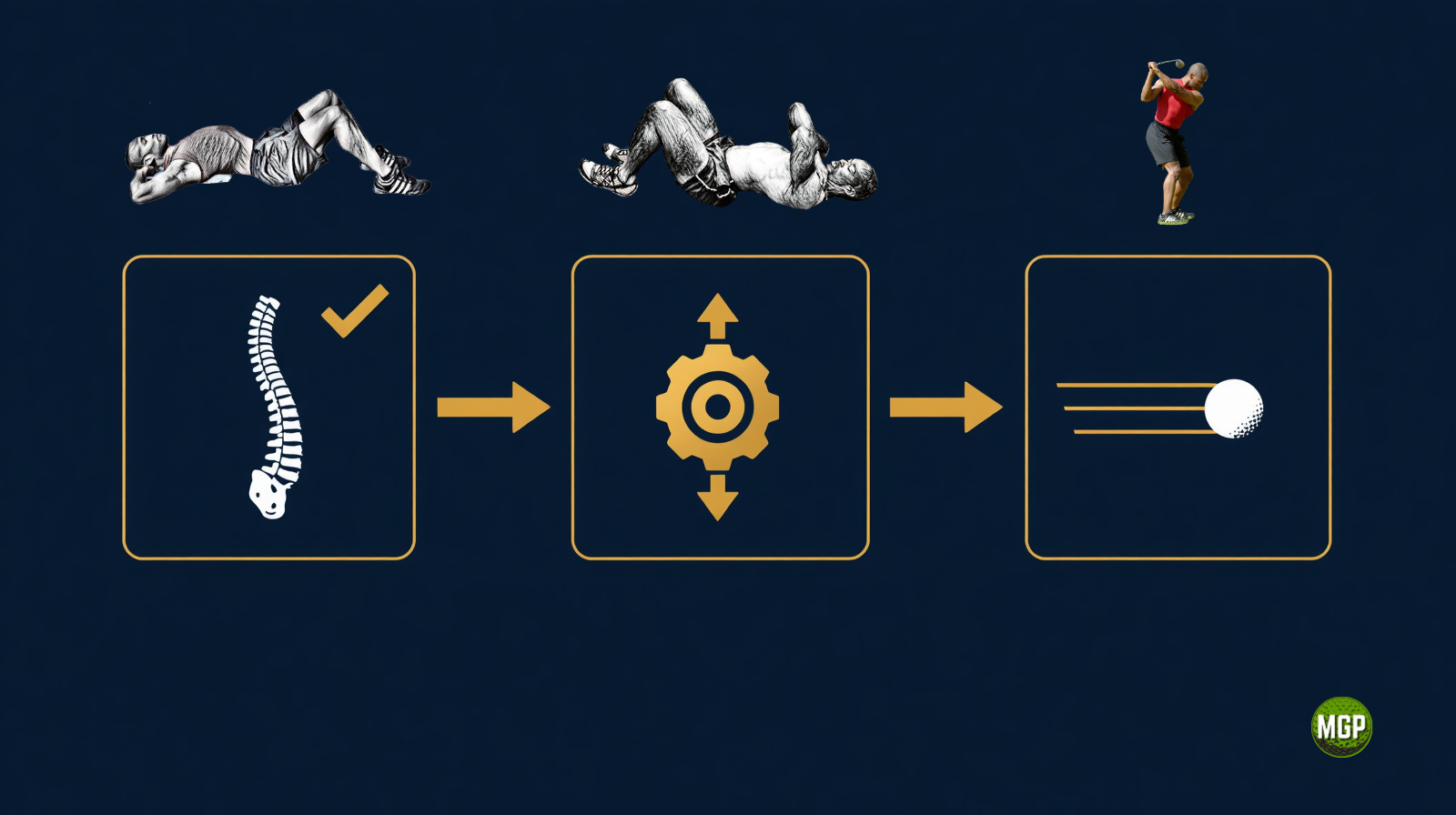
Here’s the part most golfers don’t expect.
The spinal engine is not a fixed asset. It’s not something you’re born with or without. It responds to specific, targeted training and it responds fast when you train it correctly.
The key is working with the developmental movement hierarchy. When we go back to the ground-based segmental loading patterns that the human nervous system was built on, the same patterns present in infant development, we’re re-educating the thoracolumbar coupled rotation from the ground up.
This is not stretching. Stretching changes tissue length temporarily. What we’re doing is reprogramming the motor pattern. In other words, rewriting the locomotive software that drives the engine.
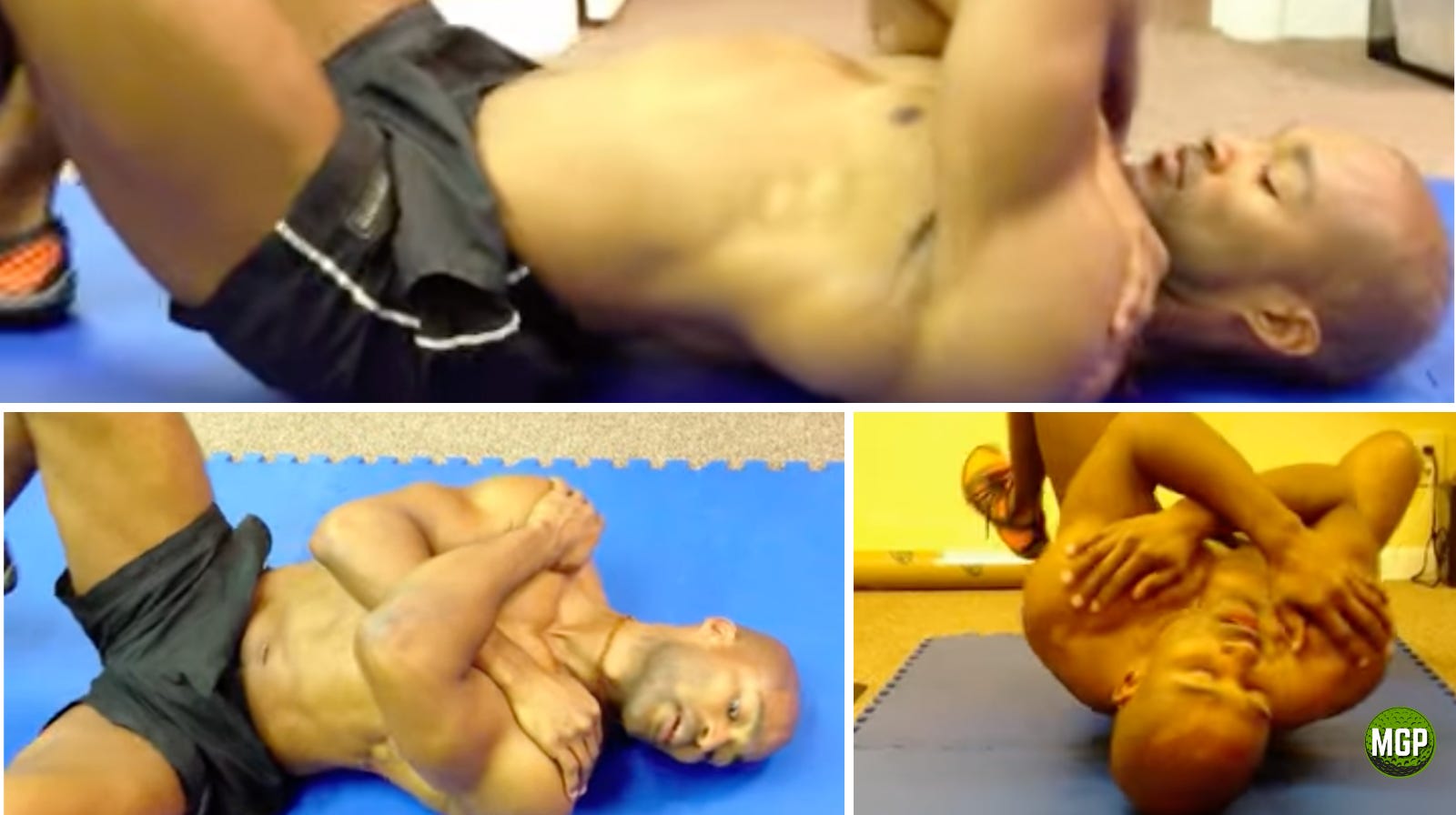
The inchworm drill in the Maximum Golf Performance protocol is a direct application of this. Every rep loads and unloads the thoracolumbar junction in the exact coupled rotational pattern Gracovetsky identified. You’re not working flexibility. You’re rebuilding the neuromotor program.
It teaches each vertebral segment to move independently before integrating into the full rotational pattern.
When the engine starts firing correctly and the head is stacked over the shoulders, the rib cage is open and mobile, the pelvis is in neutral alignment; the rotational force it generates doesn’t just feel different.
It measures differently.
Club head speed. Ball speed. Carry distance. Launch angle. Attack angle. Every measurable output of the golf swing improves when the engine it runs on is healthy.
Not because your swing changed. Because your body can finally execute the swing you already know.
The Fastest Path from Here to There
Before you can train the engine, you need to know its current condition. Which of the Three Amigos is your dominant structural dysfunction? Where is the chain breaking? What is the compensation pattern your body has built around it?
Those answers determine everything .
Which muscles to activate first, which mobility work to prioritize, which swing faults will self-correct once the structure is addressed, and how long the process will take.
That’s what the 3 Amigo Postural Assessment gives you.
What Gracovetsky Understood That Most Golf Coaches Don’t
I want to leave you with this.
Serge Gracovetsky spent his career proving that movement starts from the inside out. That the primary driver of human locomotion is not external, not the swing plane, not the grip, not the stance. It’s a coordinated spinal mechanism that either works correctly or it doesn’t.
When it works, everything downstream works.
When it doesn’t, you’re compensating. You’re managing. You’re taking lessons that teach your arms to work around a spine that isn’t doing its job. And you’ll keep taking those lessons, keep getting technically correct instruction, and keep wondering why nothing sticks.
Most golf instruction focuses on the expression of the engine. The arms, the club path and the ball flight. That’s the visible part of the swing. That’s the part that shows up on video.
What I do is different.
I go to the engine.
And when you rebuild the engine, the spine is aligned, the Three Amigos are in position, and the thoracolumbar junction is generating the coupled rotation it was designed to produce, the swing changes you’ve been chasing for years start to happen on their own.
Not because you finally learned to swing correctly.
Because your body can finally execute what it already knows.
Go take the 3 Amigo Posture Assessment and start fixing your swing from the inside out.
Would you say this is still true for those who don’t struggle with distance?
Focusing on the "Engine" is great advice. Thanks for sharing. As my good buddy always says, "Head up, eyes down, now put a nice smoothy on it". Keeping the head back is critical.